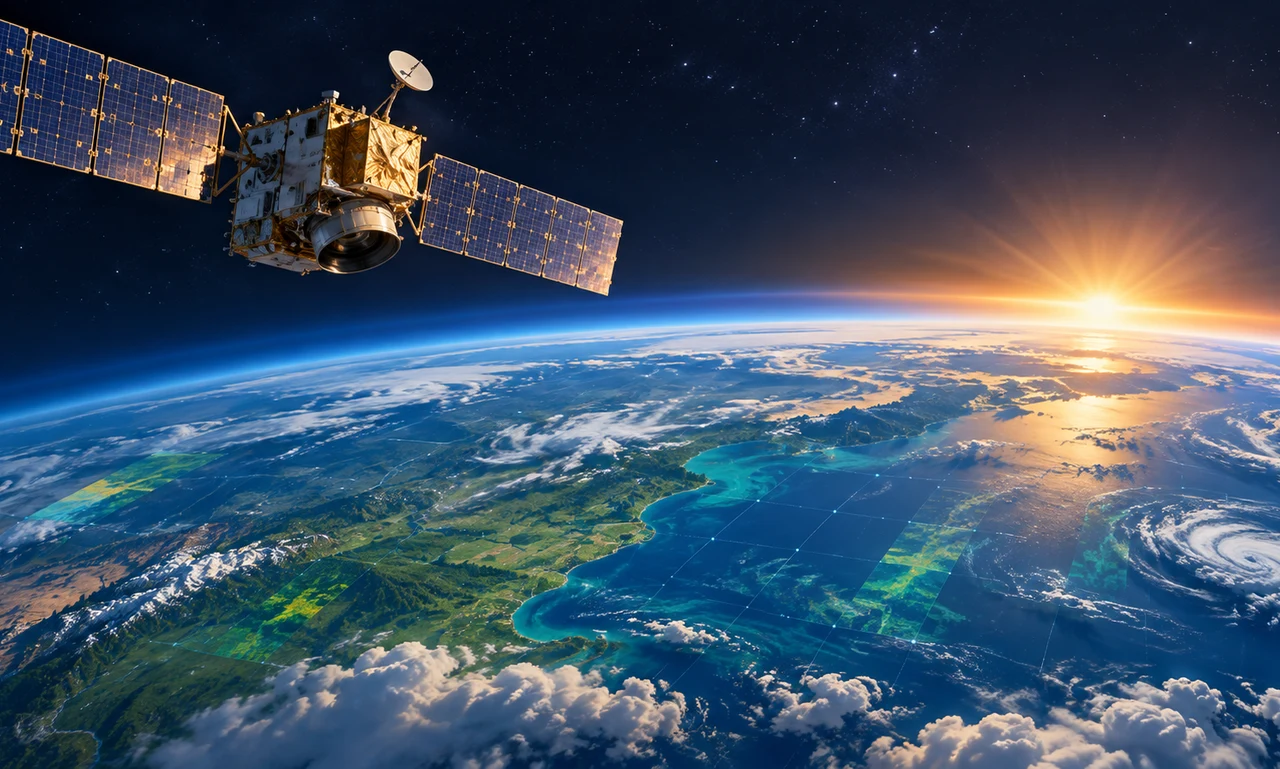
NASA’s Terra satellite will stop gathering science data on December 1 after 27 years in orbit. Launched in December 1999 for a mission originally planned to last six years, the spacecraft became one of the most durable observers in NASA’s Earth Observing System.
Terra’s importance comes from continuity as much as longevity. Its instruments followed changes in land use, wildfire behaviour, dust and smoke, atmospheric chemistry, ice cover and the movement of energy through Earth’s climate system. A record extending across more than a quarter of a century gives researchers a consistent way to compare conditions over time.
Five instruments, one connected view
The spacecraft carried five instruments designed to examine different parts of the planet. MODIS produced wide-ranging views of land, ocean and atmosphere. MISR studied reflected light from several angles, while ASTER provided detailed surface observations. CERES measured radiation in the Earth system, and MOPITT tracked carbon monoxide in the lower atmosphere.
Some instruments or components had already been switched off to conserve power. NASA said aging spacecraft systems and a drifting orbit now make the end of operations necessary. The team plans to use remaining fuel to lower Terra’s orbit before powering off the spacecraft in January 2027.
The archive continues after the spacecraft
Ending operations does not erase Terra’s scientific value. NASA says its data records will remain free and publicly available. Those observations have supported work in agriculture, water management, disaster response and public safety, as well as climate and atmospheric research.
The mission’s closing phase is therefore less a disappearance than a handover. Newer satellites will continue watching Earth, while Terra’s archive remains a reference point for understanding what changed, when it changed and how separate parts of the planet’s system influenced one another.