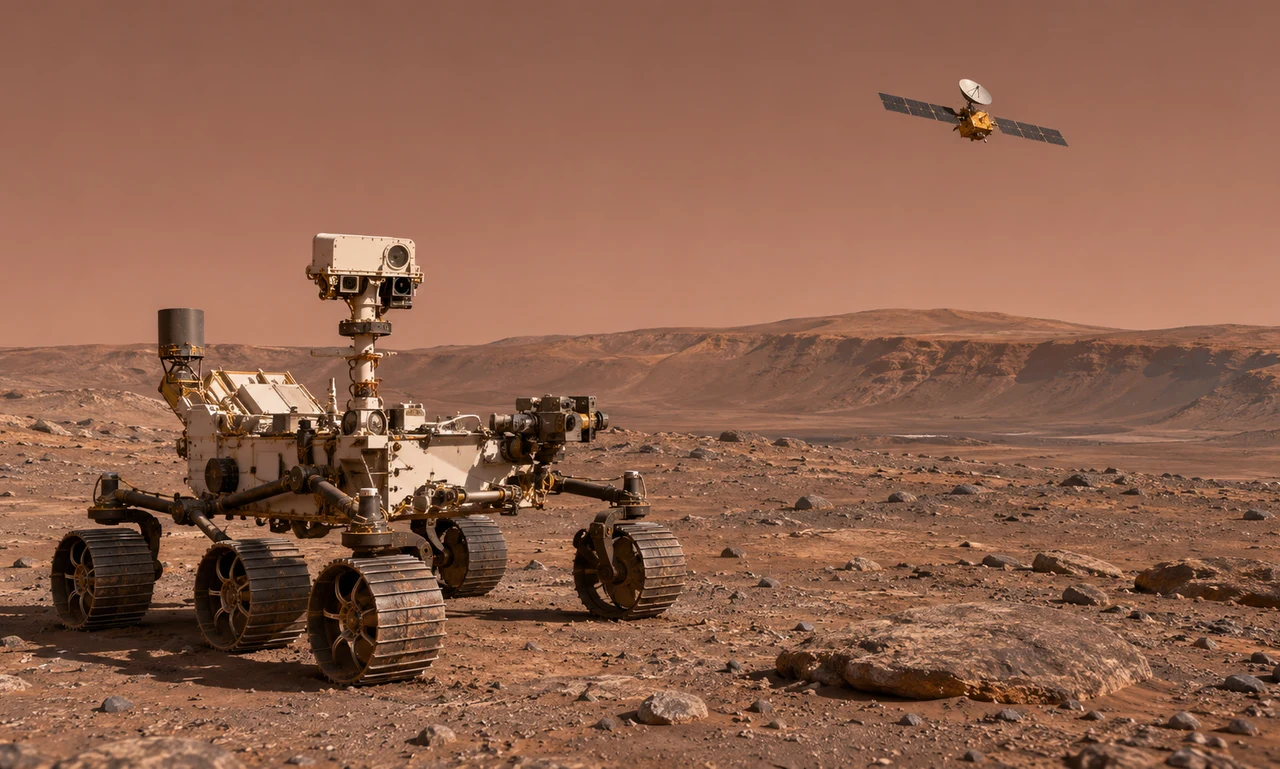
NASA teams are investigating separate technical problems affecting the Perseverance rover and the 2001 Mars Odyssey orbiter. Both spacecraft remain in communication, but science activities have been paused while engineers protect hardware and study diagnostic data.
Perseverance’s issue began when its primary UHF radio stopped sending the electronic heartbeats expected by the rover’s main computer. After 25 missed signals, representing about 100 seconds, onboard fault protection shut down the radio, switched to a backup and placed the rover in safe mode.
A backup revealed a second question
Engineers recovered the rover from safe mode, then found that the backup UHF radio was transmitting at roughly half its expected power. Both relay radios are now being left unused until the team understands the cause and determines which can operate safely.
Perseverance can still speak directly to NASA’s Deep Space Network through its high-gain antenna using X-band communications. That route carries data more slowly than transmission through Mars orbiters, so camera and instrument work has stopped to preserve bandwidth for engineering information.
Odyssey is testing a wheel after 25 years in orbit
The Odyssey orbiter has a different problem. One of its reaction wheels stopped spinning, temporarily taking its science instruments offline. Spacecraft use these wheels to change orientation without constantly firing thrusters.
Odyssey began with four wheels, but one failed in 2013. At least three are needed for normal wheel-based control. Engineers have moved the remaining malfunctioning wheel during a test and are checking whether it can return to service.
Relying only on hydrazine thrusters would consume limited fuel. NASA estimates Odyssey has enough hydrazine for roughly one to two months of orientation control without the required reaction wheels, although that estimate is still being refined.
Teams hope both missions can resume science by the end of November. The pauses illustrate why distant spacecraft carry fault protection and redundant hardware: not every failure can be prevented, but a machine can be designed to remain stable long enough for people on Earth to understand what happened.