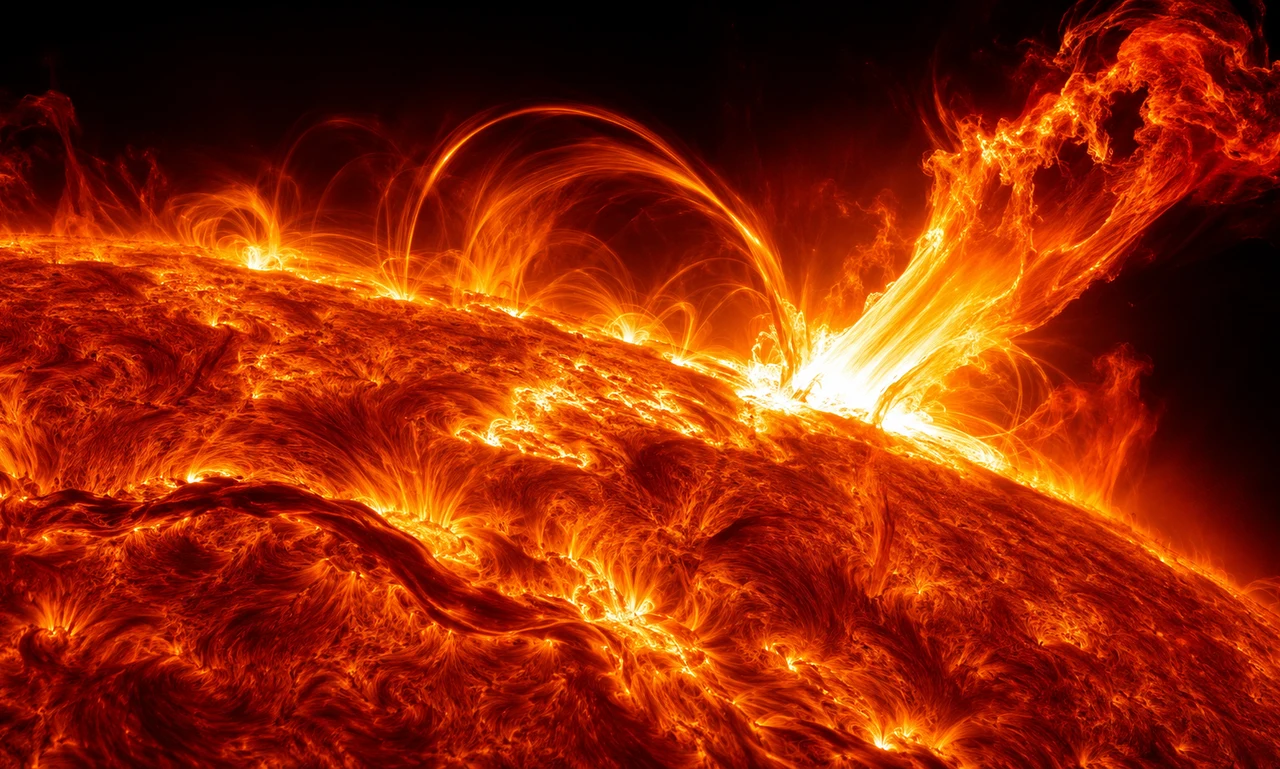
A dramatic close view of the Sun’s chromosphere is the subject of NASA’s Astronomy Picture of the Day for November 18. The image records energized hydrogen during a medium-strength flare, revealing the structured and constantly changing atmosphere above the visible solar surface.
The photograph was made with an H-alpha filter, which isolates a narrow wavelength of red light emitted by hydrogen. This technique allows solar observers to see filaments, prominences and active regions that would be difficult to distinguish in ordinary white-light images.
Magnetic energy shapes the eruption
The Sun’s atmosphere is threaded by magnetic fields generated by the motion of electrically charged material. These fields can twist, store energy and suddenly rearrange. During a flare, that stored energy is released as radiation and accelerated particles.
The featured eruption occurred on May 14, 2025, and was classified as an M1 flare using observations from the GOES satellite system. Solar flares are grouped by their X-ray brightness, with M-class events below the most powerful X-class category.
Why agencies monitor solar activity
A flare of this scale can affect high-frequency radio communication near Earth’s polar regions and may contribute to a minor radiation storm. The effects vary according to the eruption’s position, direction and whether it is accompanied by a larger release of solar material.
Monitoring gives satellite operators, aviation services and human spaceflight teams time to understand developing conditions. Agencies including NASA and NOAA combine observations from the Sun and near-Earth space to assess when solar activity may affect technology or astronauts.
The image is visually spectacular, but it also captures a physical process with practical consequences. A glowing arc above the Sun is the visible trace of magnetic energy moving through an atmosphere that can influence conditions far beyond the star itself.