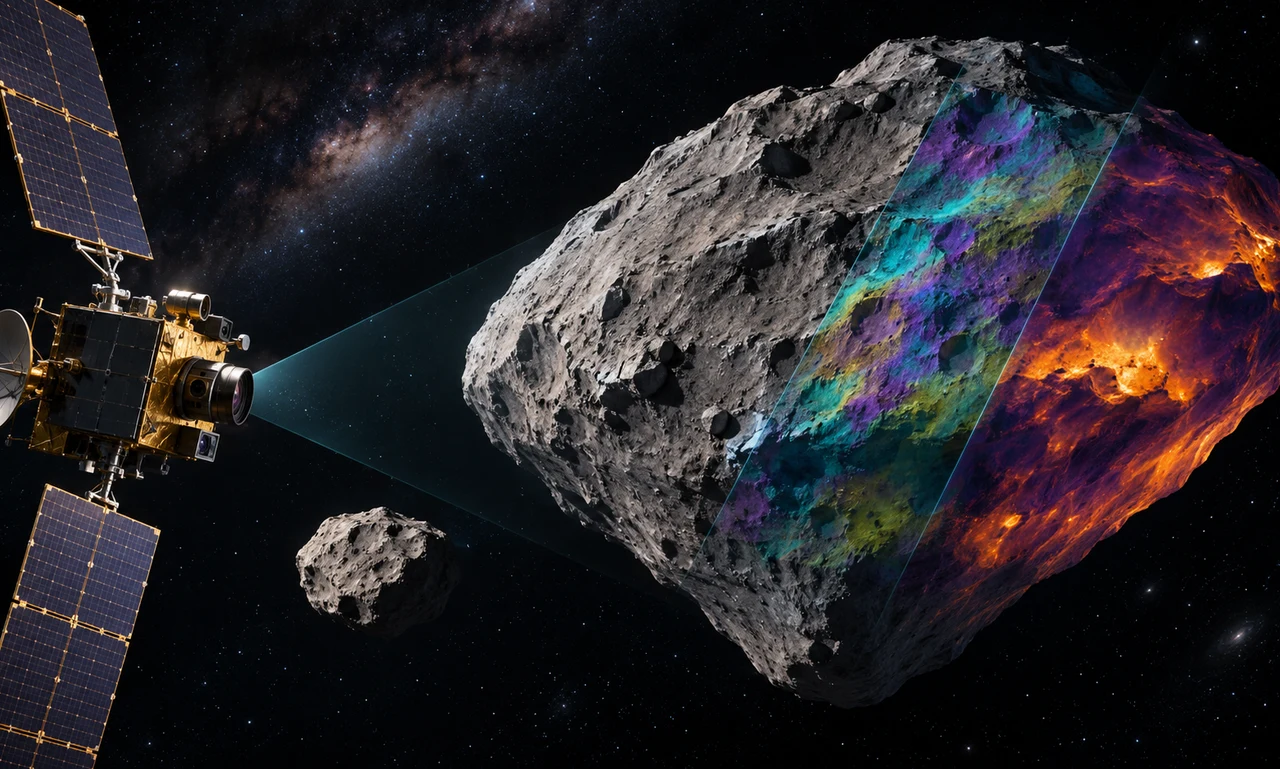
The European Space Agency’s Hera spacecraft is examining the Didymos asteroid system through several forms of light, giving researchers complementary views of terrain, composition and temperature. ESA released the new observations on November 17 after the spacecraft approached to within 28.5 kilometres of its target.
Hera is investigating Didymos and its smaller moonlet, Dimorphos, as part of a planetary-defence mission. Dimorphos was struck by NASA’s DART spacecraft in 2022 in the first full-scale test of changing an asteroid’s orbit through a deliberate impact.
Three instruments, three kinds of evidence
Hera’s Asteroid Framing Camera produces monochrome images used for navigation and science. At the reported distance, it resolved features at about 2.7 metres per pixel. The views show boulder-rich areas, clearer terrain and possible signs of material moving toward Didymos’s equatorial ridge.
HyperScout H observes reflected light across 25 colour bands, extending from visible red into near-infrared. Subtle differences between those bands can be compared with laboratory measurements of meteorites and minerals to investigate what the surface is made of.
A thermal-infrared imager supplied by the Japan Aerospace Exploration Agency maps temperature differences. How quickly a region heats and cools can help distinguish solid rock from fractured, porous or loose material.
Seeing a moonlet hidden in shadow
Dimorphos measures about 151 metres across and orbits the 780-metre Didymos. In the visible observations, most of the moonlet was in shadow, with only a small sunlit area showing. Thermal infrared still revealed the body through heat emitted from its surface.
These measurements support Hera’s wider investigation of how the DART impact affected Dimorphos. Researchers want to understand its structure, mass and surface, all of which influence how an impact changes an asteroid’s motion. ESA plans to unveil more detailed images of both bodies on November 25.