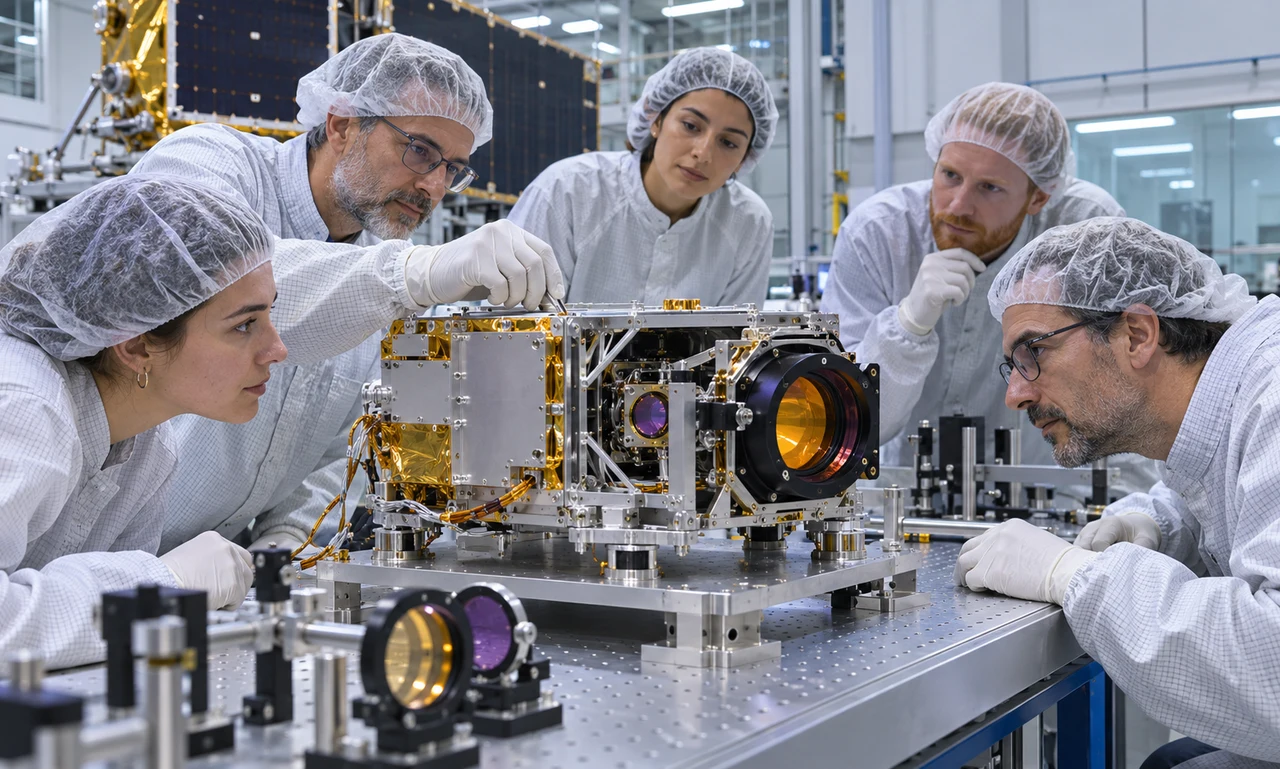
A scientific question may begin with a sketch on a whiteboard, but reaching space requires years of engineering, testing, documentation and coordination. For four decades, the European Space Agency’s Prodex programme has helped national research teams cross that gap.
Prodex — the Programme for the Development of Scientific Experiments — marked its 40th anniversary with a gathering in Zurich. Switzerland was the first country to join the programme in 1986; today it brings together 17 participating states, research institutes, industry and ESA.
The missing bridge to flight
Prodex is not intended as a general technology-development fund. Its role is more specific: transform scientific and technical concepts into instruments and experiments ready to fly. That includes refining designs, meeting mission requirements, qualifying hardware and coordinating the specialist organizations needed to deliver it.
Supported developments appear on missions including Solar Orbiter, BepiColombo, Cheops and Smile, as well as experiments aboard the International Space Station. The work spans space science, Earth observation, exploration, navigation and space safety, along with national missions and international partnerships.
Preparing instruments for the next questions
Europe’s Voyage 2050 science programme is looking toward ocean worlds, temperate exoplanets and the early Universe. Those goals demand detectors and instruments that may not yet be mature enough for a mission proposal.
A 2025 call asked scientists and industry to identify capabilities that could shape future missions. ESA received 32 submissions and selected 11 for development into project proposals, with implementation considered for early 2027 if participating delegations confirm funding.
Support for Prodex has grown: subscriptions increased by 38 per cent at ESA’s previous ministerial council, and some states expect annual commitments to rise further from 2027.
The programme’s longevity reflects a practical truth about discovery. A telescope, sensor or laboratory experiment is not only an idea and not only a manufactured object. It is a negotiated meeting point between the question scientists want to answer and the conditions a spacecraft can survive. Prodex has spent 40 years making that meeting possible.