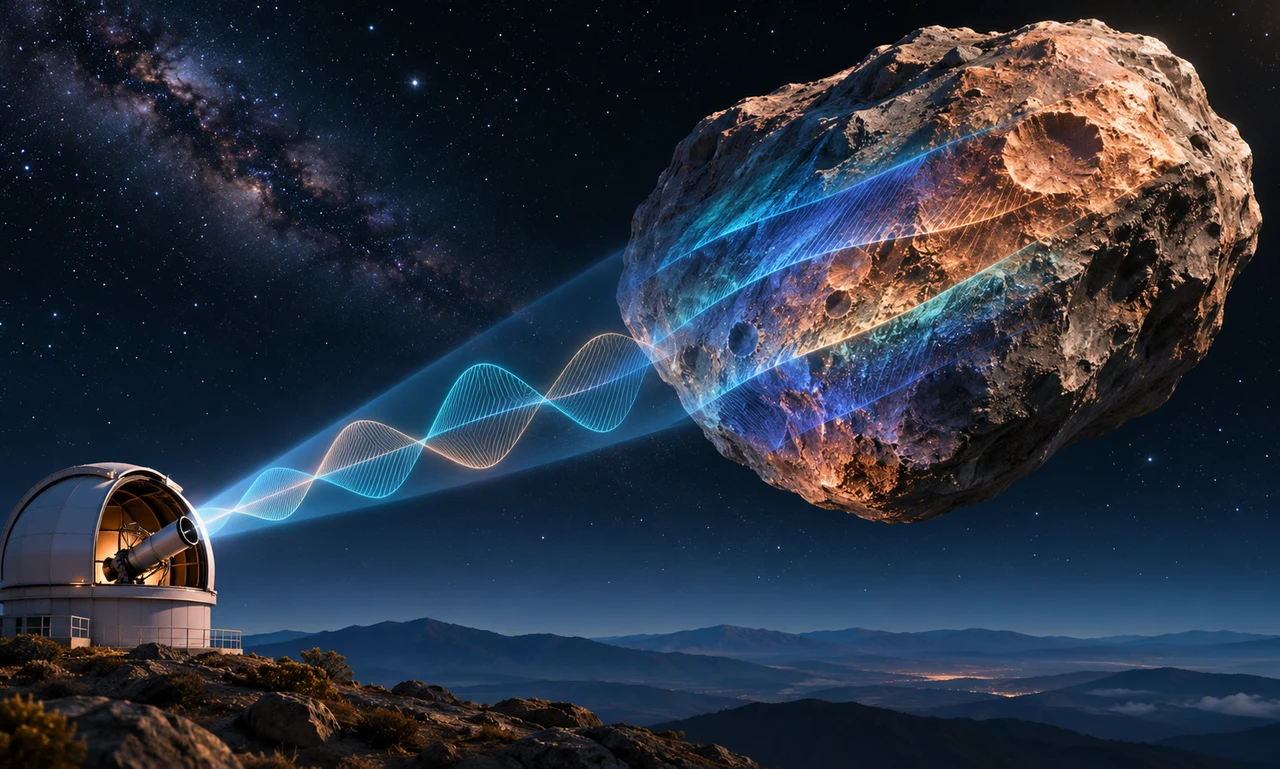
The European Space Agency’s Near-Earth Object Coordination Centre has released PANDA, a web service that estimates asteroid albedo from polarimetric observations. The service is intended to support rapid physical characterization, especially when a newly discovered object has only a short observing window.
An asteroid’s apparent brightness does not reveal its size on its own. A small, highly reflective body can appear as bright as a larger, darker one. Astronomers need an estimate of albedo — the fraction of light reflected by the surface — before they can turn brightness measurements into a more useful diameter estimate.
Reading the orientation of reflected light
Polarimetry examines the orientation of light waves after sunlight scatters from an asteroid’s surface. The way that polarization changes with viewing angle can reveal information about reflectivity and surface properties. PANDA brings that analysis into a web-based workflow.
Better size estimates matter because diameter is central to understanding an asteroid’s physical nature and the possible effects of an impact. The service does not replace orbital tracking: knowing where an object is going and knowing how large it may be are separate questions. Both contribute to a fuller assessment.
Designed for time-sensitive observations
Newly detected near-Earth objects can fade quickly or move into a position where they are difficult to observe. A service that shortens the path from polarization measurements to an albedo estimate can help observers make use of limited data while the target is still available.
PANDA also illustrates the layered nature of planetary defence. Discovery surveys find objects, follow-up observations improve their orbits, and physical measurements help researchers understand what those objects are. No single tool supplies the entire answer, but each can reduce a different kind of uncertainty.