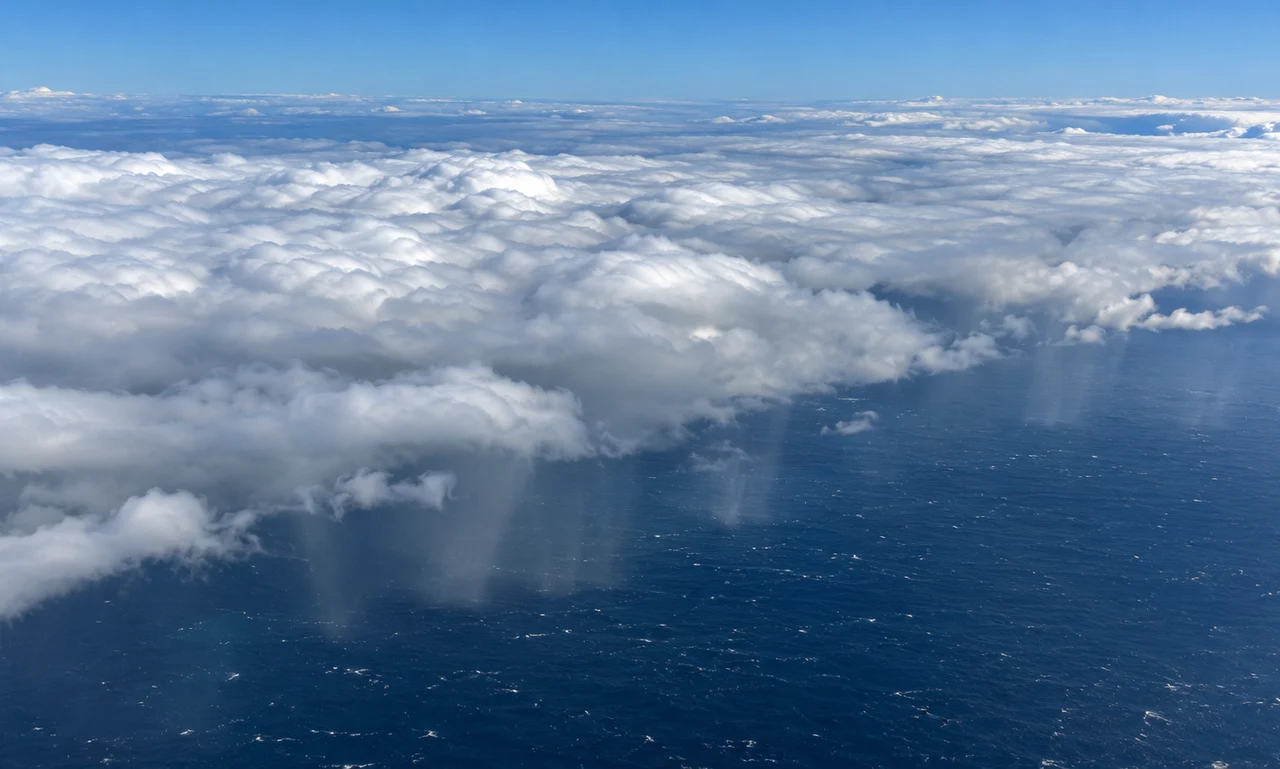
Some of Earth’s most important natural sunshades stretch across the ocean only a short distance above the water. Marine stratocumulus clouds form broad, bright sheets that reflect incoming sunlight back to space, helping to moderate the planet’s temperature.
New observations from the European Space Agency’s EarthCARE satellite suggest that rain can help break those sheets into fragmented patterns. The finding connects tiny changes inside cloud droplets with a much larger effect on how much solar energy the ocean absorbs.
A cloud deck can reorganize without disappearing
Cloud breakup does not necessarily mean the sky becomes clear. A continuous closed-cell deck can change into an open-cell pattern with gaps between cloud walls. Those openings expose the dark sea surface, which absorbs more sunlight than the bright cloud above it.
Researchers combined two views from orbit. A geostationary satellite tracked how the clouds changed over time, while EarthCARE measured their vertical structure, precipitation, falling droplets and the aerosol particles involved in forming them.
The observations point to a self-reinforcing process. When rain begins, falling drops remove aerosol particles from the air. With fewer particles available to seed droplets, the remaining droplets grow larger and become more likely to fall. Continued rain can then disrupt the circulation that maintains the solid cloud sheet.
Small droplets influence the planetary energy budget
Marine stratocumulus clouds are difficult to study from space because they form close to the ocean. EarthCARE’s instruments can profile that low layer in ways earlier orbital cloud radars could not.
The work matters because Earth is reflecting less sunlight than it once did, and declining marine cloud cover is one possible contributor. Scientists still do not know whether the trend will continue or accelerate as the climate warms.
One observed transition cannot answer that global question. It does provide a mechanism that climate models can test against a growing record of measurements. Better understanding of rain, aerosols and cloud organization may help explain why a bright ocean cloud deck persists on one day and opens on another.