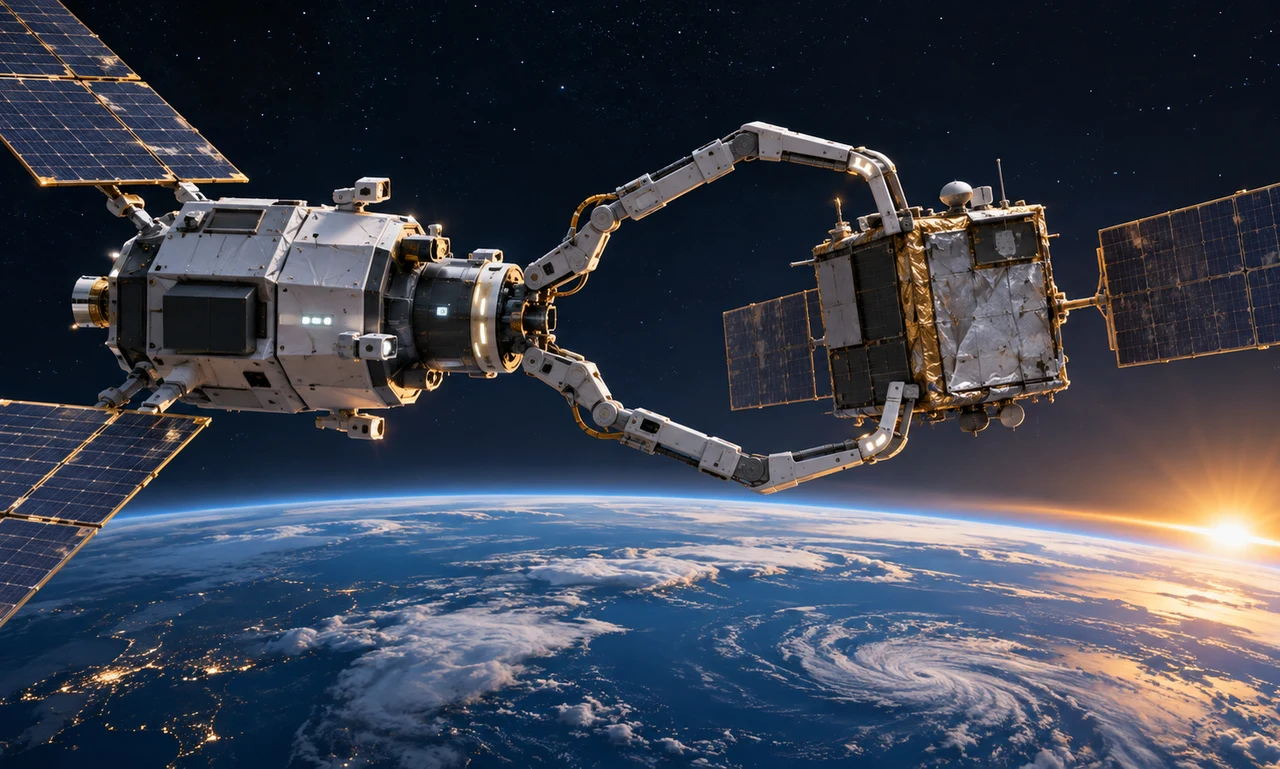
The European Space Agency and prime contractor OHB System have moved ClearSpace-1 into its construction phase, advancing a mission intended to demonstrate that a dead satellite can be captured and removed from orbit.
The agreement was signed November 17 at Space Tech Expo Europe in Bremen, Germany. An industrial team led by OHB SE, with ClearSpace SA, Indra and OHB Sweden as subcontractors, will now turn the mission design into a flight-ready spacecraft. Launch is scheduled for 2030.
A target that cannot assist its rescuer
ClearSpace-1 will target Proba-1, an ESA spacecraft launched in 2001 that ended regular operations in 2022. Proba-1 was not designed with docking equipment for a later removal mission, making it what engineers call an unprepared and uncooperative object.
The cleanup spacecraft will need to locate the target precisely, approach it safely, match its motion and capture it without help from the inactive satellite. It must then guide both vehicles toward a controlled re-entry into the atmosphere.
Testing a service that future orbits may need
Thousands of satellites and rocket bodies have been left in orbit. Collisions can create many smaller fragments, increasing risk for operating spacecraft. Avoiding new debris is essential, but existing objects also create a case for active removal.
ESA describes ClearSpace-1 as part of its work on active debris removal and in-orbit servicing. A successful demonstration would provide engineers and regulators with evidence about the cost, reliability and practical limits of removing stranded hardware.
The mission will not solve orbital debris on its own. Its significance lies in proving a sequence of difficult tasks in space and helping establish whether cleanup can become a repeatable service rather than a one-time experiment.