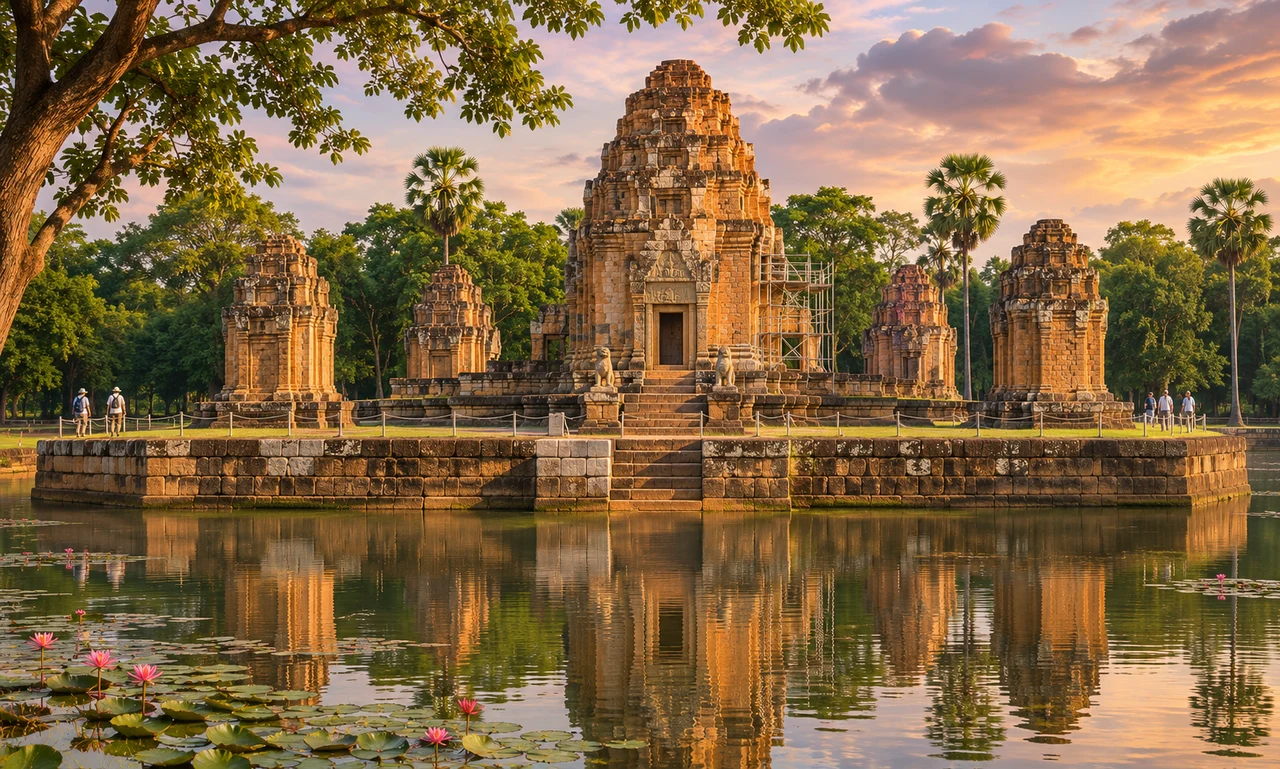
The rehabilitation of Western Mebon Temple has been inaugurated at Angkor, placing a restored monument back within one of the world’s most closely watched cultural landscapes.
UNESCO Director-General Khaled El-Enany joined Cambodia’s King Norodom Sihamoni and French President Emmanuel Macron for the event during a visit marking 75 years of Cambodia’s UNESCO membership.
A monument belongs to a larger system
Western Mebon stands on an island in the West Baray, the vast reservoir at Angkor. Its setting connects architecture with the water engineering, settlement patterns and sacred geography that shaped the Khmer capital.
Conservation in such a place cannot be reduced to replacing stones. Archaeologists and craftspeople must understand how the structure was built, how water and vegetation affect it, which materials can be reused and how new work can remain distinguishable without disrupting the whole.
The inauguration also reflects decades of international coordination. At Angkor Wat and the Bayon complex, Cambodian institutions work with foreign specialists through programmes including the Japan-APSARA Safeguarding Angkor project, active since 1994. The goal is not simply to bring in outside expertise, but to support local training and long-term management.
Heritage protection extends across Cambodia
UNESCO’s work includes other World Heritage places such as Koh Ker, Sambor Prei Kuk and Preah Vihear. In 2026, it mobilized international emergency support for conservation at Preah Vihear at the Cambodian government’s request.
The visit also connected monuments with education and difficult memory. Cambodia launched a new teacher policy and a report on a decade of reform. At the Tuol Sleng Genocide Museum, a separate programme supports archive conservation, digitization and educational tools about Khmer Rouge atrocities.
These activities show different forms of preservation. A temple requires structural care and landscape management. An archive needs stable records and access. A painful historic site needs interpretation that respects victims and helps future generations understand what occurred.
Western Mebon’s return is therefore more than the completion of a construction project. It is evidence that heritage survives through continuity: skilled local stewardship, patient research, public education and cooperation maintained long after the ceremonial opening ends.