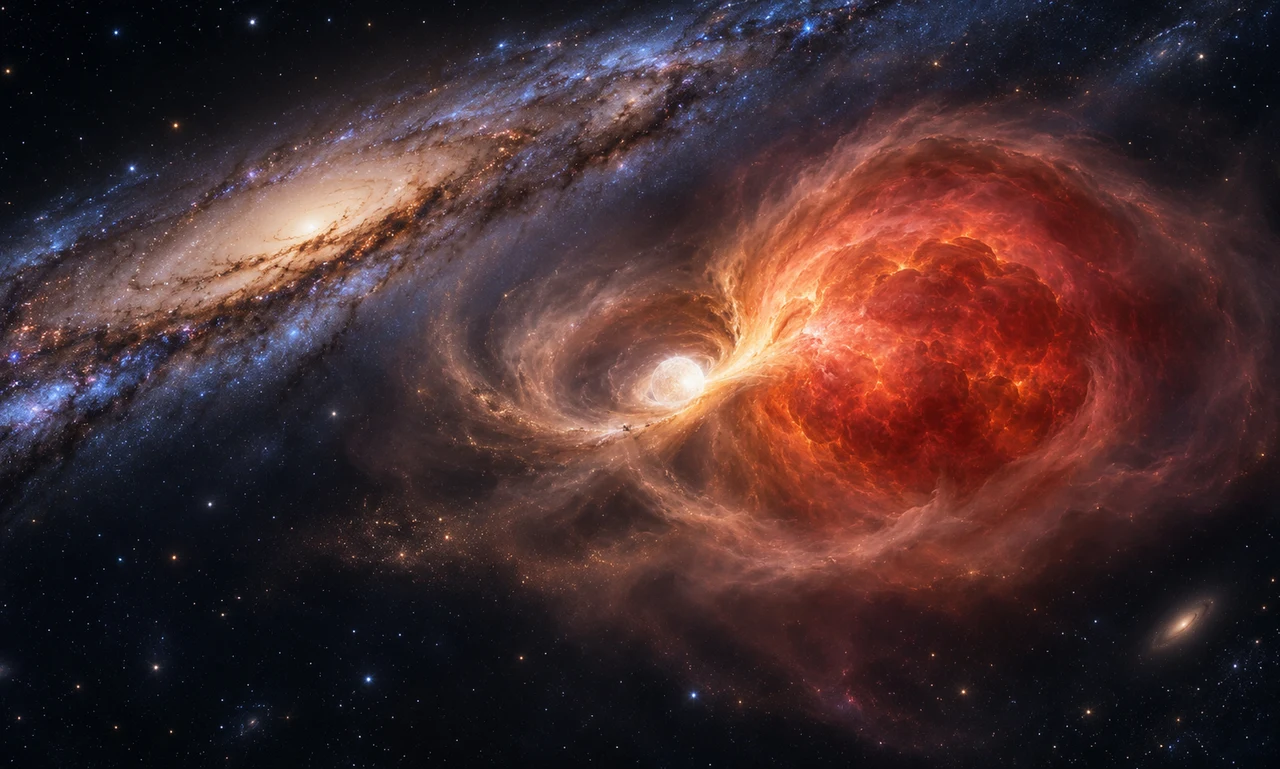
Astronomers have reconstructed an unusual stellar merger at the edge of the Andromeda galaxy, following the system closely enough to see crucial stages as they happened. The event involved a star slightly less massive than the Sun spiralling into a swollen supergiant, leaving behind a single object the research team nicknamed Bao.
Stellar mergers are difficult to catch because no timetable announces when two stars will finally combine. In this case, an odd source in archived observations drew attention years before the eruption, giving researchers a rare chance to keep watching.
Clues arrived across the spectrum
Bao first stood out in February 2023 in data from NASA’s retired NEOWISE mission. Earlier records showed a steady object, while later observations revealed slow brightening and the release of dust. In July 2025, SPHEREx saw the system fade in visible light while becoming brighter in infrared — a sign that surrounding dust was reshaping what telescopes could see.
The Zwicky Transient Facility detected the eruption on October 17, 2025. Follow-up observations came from several facilities, and the James Webb Space Telescope observed Bao on December 24, only 47 days after the eruption peaked. NASA says this was the earliest Webb follow-up of an event of this kind.
A rapid end to a long orbit
The two stars had orbited each other for millennia. Once the smaller companion began interacting with the giant star’s extended outer layers, the final union took only seven orbits — about seven years. Gas peeled away, dust formed and the system’s brightness rose sharply.
By combining ultraviolet, visible and infrared evidence, the team could estimate how much material was expelled and study the efficiency of the shared-envelope stage that preceded the merger. That makes Bao more than a spectacular outburst: it is a test case for how close stellar pairs evolve into one.
The timing is useful for future surveys. NASA’s Roman Space Telescope is expected to find large numbers of changing and transient objects. Bao shows how early warning from broad surveys, followed by rapid observations from several telescopes, can turn a distant flash into a detailed physical history.